 Back to Guides
Synthetic vs. Felt Underlayment: A Decade of Field Lessons


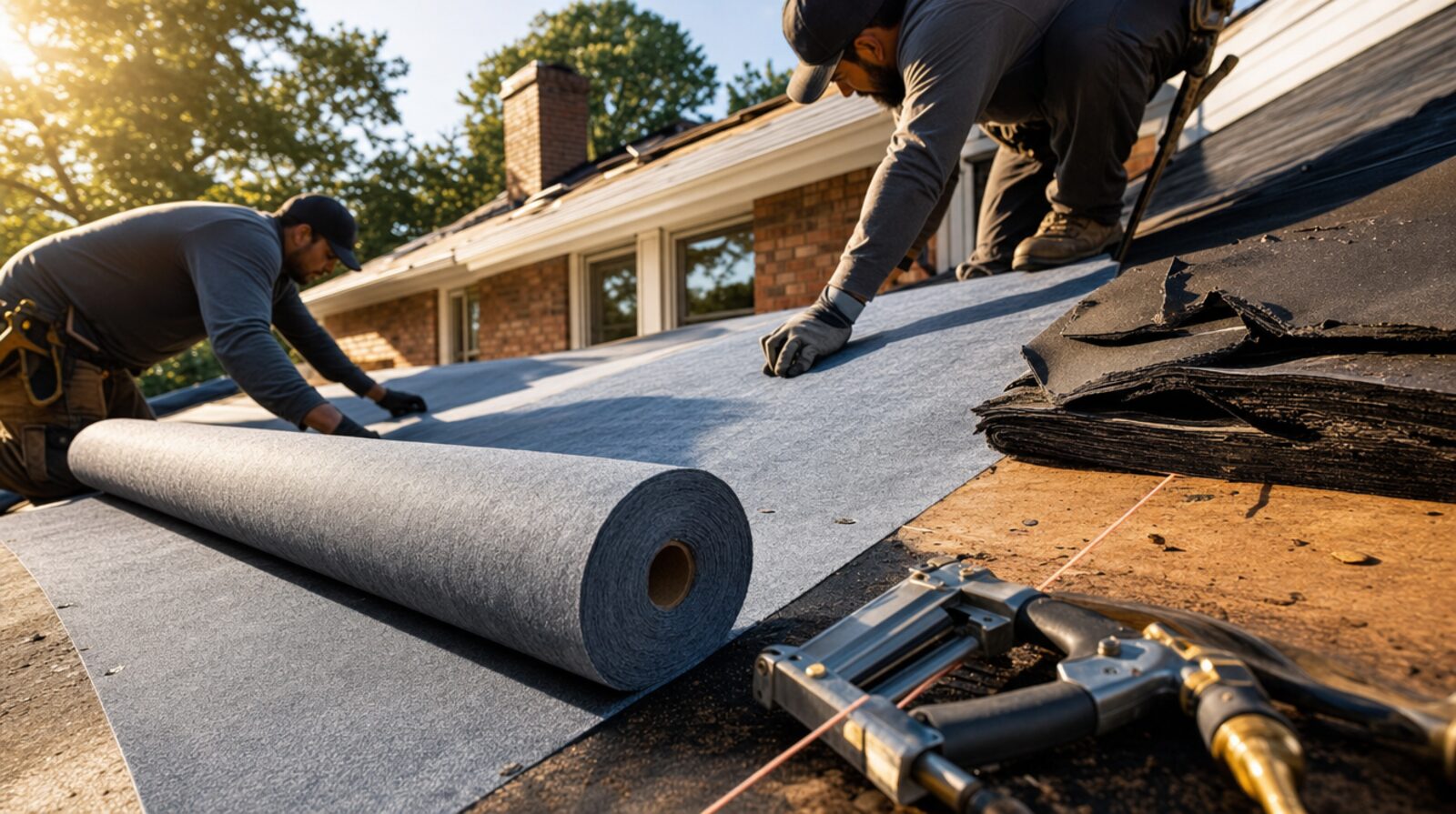
Every underlayment product on the market claims to keep water out. The claim that matters is what the material looks like five, ten, or fifteen years later when we pull shingles for a re-roof and the deck is finally exposed again. Over years of tear-offs across Greensboro, High Point, and Winston-Salem, we've opened up a lot of roofs that were installed with old-fashioned asphalt-saturated felt and a growing number that were installed with synthetic underlayment. The differences aren't subtle once you're standing on the deck.
What Felt Does Well, and Where It Gives Out
Traditional #15 and #30 felt has been the industry default for generations, and there's a reason it stuck around so long — it's cheap, it's forgiving to nail through, and when it's covered quickly with shingles it does its job. The trouble shows up in three places we see over and over on Triad roofs:
- Moisture cycling. Felt is paper with asphalt saturation. Humidity swings common in a Piedmont summer cause it to absorb moisture, wrinkle, and dry out repeatedly. That wrinkling telegraphs through architectural shingles over time, especially on decks with any plywood movement.
- UV exposure during construction. If a felt underlayment sits exposed for more than a few days before shingles go on — which happens on larger jobs or when weather delays a crew — it starts to degrade, crack, and lose its water resistance right where you need it most.
- Tear resistance in wind events. Felt tears easily along the nail line in gusty conditions. On a partially stripped roof caught by an afternoon thunderstorm, that's the difference between a dry attic and a soaked one.
None of this means felt is a bad product. On a tight budget, with a crew that dries the deck in fast, felt still performs adequately. But it has a narrower margin for error than what's replaced it.
Why Synthetic Has Become Our Default
Synthetic underlayment — woven or non-woven polypropylene or polyethylene sheets — solves most of felt's weak points directly:
- It doesn't absorb water. Synthetic sheets shed moisture instead of soaking it in, so there's no wrinkling and no telegraphing through the shingle line months later.
- It survives extended UV exposure. Most synthetic products are rated for 30 to 180 days of sun exposure before shingles go down, compared to a few days for felt. That matters on a Triad job when rain pushes a schedule, or on a large commercial or multi-family roof where full deck coverage takes longer than a single day.
- It's dramatically stronger underfoot. Synthetic underlayment has a much higher tear strength, which matters twice: once during installation, when crews are walking the deck repeatedly, and again if a storm strips shingles before a tear-off is finished.
- It's lighter per roll and covers more square footage. A roll of synthetic typically covers 4 to 10 squares versus 2 for a roll of #30 felt, which means fewer roll changes, fewer horizontal laps, and fewer places for water to find a seam.
When we tear off a roof that had synthetic underlayment installed correctly, the sheet underneath still looks close to new — no wrinkling, no brittleness, colors still legible. That's not something we can say about felt pulled after the same span of time.
Where the Decade of Field Lessons Actually Bites
The material choice matters less than most homeowners assume compared to installation quality. We've seen synthetic underlayment fail prematurely because of shortcuts that had nothing to do with the product itself:
- Under-lapping at seams. Synthetic manufacturers publish specific overlap requirements — usually a minimum of 4 inches on horizontal laps and 6 inches on the ends. Crews in a hurry sometimes shave that down, and it's invisible until water finds the gap.
- Wrong fastener pattern. Synthetic underlayment needs more fasteners per square than many installers assume, particularly in high-wind zones or on steep pitches. Cap nails, not staples, hold it down properly through a Carolina thunderstorm season.
- Skipping ice-and-water shield at vulnerable points. Underlayment type is not a substitute for self-adhered ice-and-water membrane at valleys, eaves, chimneys, and skylight curbs. We still run that membrane regardless of whether the field underlayment is felt or synthetic.
- Mixing incompatible products. Some synthetic underlayments react poorly with certain adhesive-backed accessories or high-heat metal roofing. Always confirm compatibility with the shingle or metal manufacturer's published underlayment list before mixing brands.
What We Recommend for Piedmont Triad Homes
For most asphalt shingle roofs in this region, synthetic underlayment is worth the modest upcharge over felt — usually a small percentage of total material cost on a typical job — given our humidity, the length of our thunderstorm season, and the wind gusts that come through with summer storms. Felt still has a place on tighter budgets or smaller accessory structures where the roof will be covered the same day it's dried in.
The underlayment is the layer nobody sees again until the next roof comes off. Ten years of tear-offs has taught us it's not a place to guess.
If you're planning a re-roof, ask your contractor which underlayment they use as their standard, what overlap and fastening spec they follow, and whether ice-and-water membrane is included at the valleys and eaves regardless of the field underlayment choice. Those answers tell you more about the quality of the job than the shingle brand on the sample board.
Stop Guessing on Price
Get precise measurements and a detailed price range for your specific roof right now using our aerial measurement technology. No home visit required.
Get my price