 Back to Guides
Space Heaters, Attics, and Roof Fires: An Overlooked Winter Risk


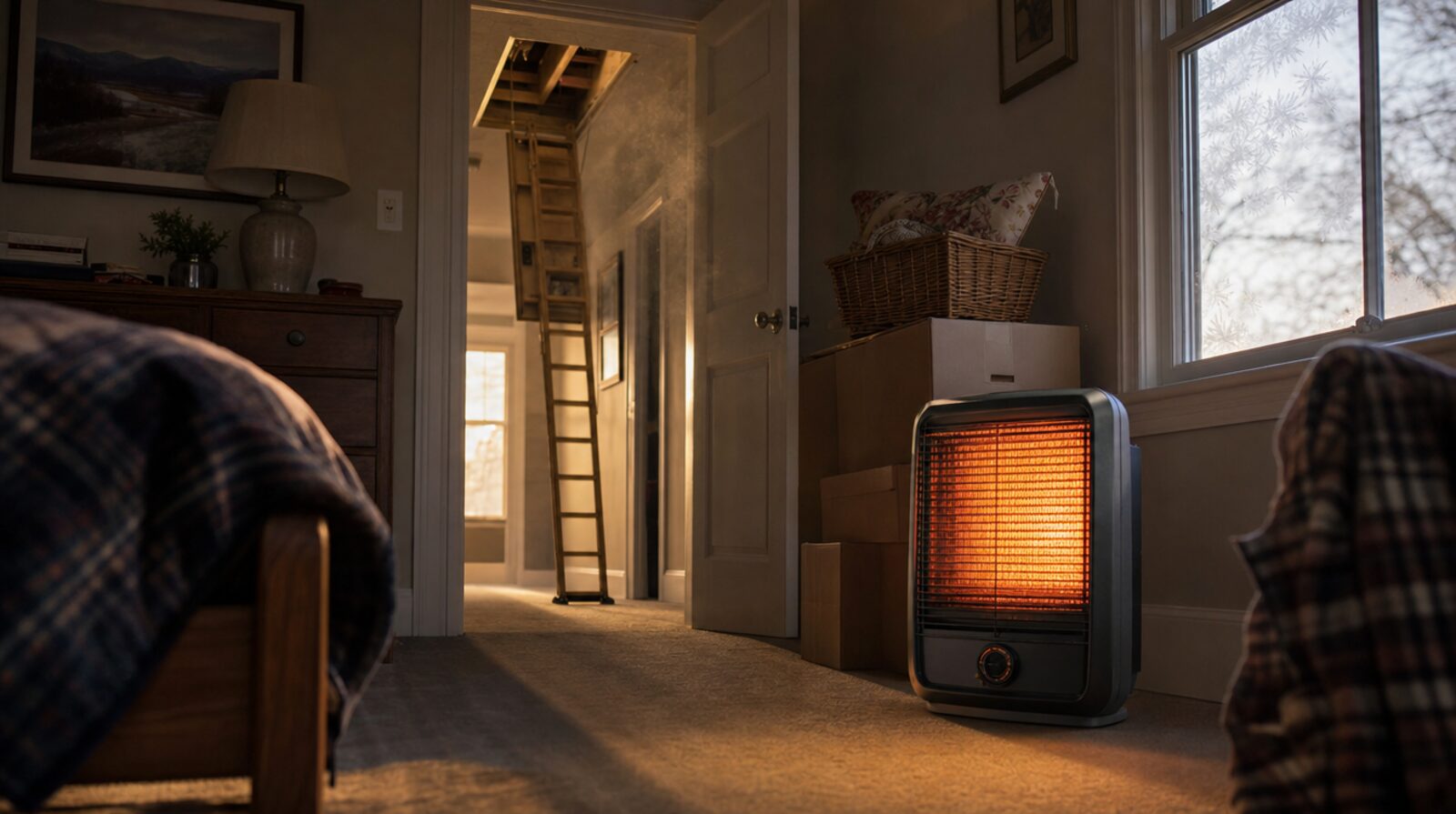
Every January we get calls about ice dams, missing shingles, and gutters pulling away from the fascia. Those are the visible winter problems. The one that worries us more doesn't show up on the roof at all until it's too late — it starts with a space heater plugged in near an attic access panel, a knee wall, or a crawlspace that somebody's trying to keep from freezing.
We've walked enough attics in Greensboro, High Point, and Winston-Salem to know how much gets stored up there that has no business being near a heat source: old insulation batts, cardboard boxes, dried-out wood framing, sometimes decades-old wiring insulation that's already brittle. Add a portable heater running unattended overnight and you've built the conditions for a fire that starts inside the structure, not on top of it.
Why Attics Are the Wrong Place for Space Heaters
Attics and roof cavities are not like living rooms. A few things stack the odds against you up there:
- Combustible materials everywhere. Fiberglass batts, cellulose blown-in insulation, roof deck sheathing, and rafters are all within a few feet of any spot you'd set a heater. Most portable heaters need three feet of clearance on all sides — attics rarely offer that in a straight line.
- Poor visibility. If a heater tips, overheats, or a cord starts to smolder, nobody's up there to notice. By the time smoke reaches a living space, the fire has often been established in the framing for a while.
- Dust and debris. Attics accumulate a layer of fine dust and, in older homes, sawdust or insulation fibers that settle on every surface, including the heater housing itself. That buildup can scorch or ignite well below what you'd expect from a clean heater in a clean room.
- Restricted airflow around the unit. Ironically, an attic can be drafty overall but still trap heat right around a space heater if it's tucked behind boxes or wedged against a rafter, which is exactly how internal components overheat.
The failure mode we see discussed most in fire investigations isn't a heater tipping over — it's radiant heat baking a nearby combustible surface for hours until it reaches ignition temperature, often well below what you'd think of as "hot." Wood exposed to sustained heat in the 200–300°F range over long periods can undergo a process called pyrophoric carbonization, where the wood's ignition point drops dramatically after repeated heat exposure. A heater doesn't need to touch anything to start a fire — it just needs time and proximity.
Where This Actually Shows Up in Triad Homes
A few specific setups we see a lot around here, all worth a second look:
- Pull-down attic stairs with a heater staged at the base. People run a heater near the attic hatch to keep the stairwell from feeling drafty. That puts it right next to wood framing and often uninsulated ductwork.
- Knee-wall storage areas in Cape Cod and bonus-room-over-garage layouts. These small triangular spaces behind sloped ceilings are common in Triad neighborhoods built from the 1960s through the 1990s, and homeowners use them as extra storage — then run a heater in there to keep pipes from freezing.
- Crawlspaces with heat tape or a heater near the rim joist. Not technically an attic, but the same logic applies: enclosed wood-framed space, minimal supervision, materials stacked close by.
- Garage attics used as workshops. These often have exposed rafters, stored fuel or solvents, and are heated more aggressively than a typical attic — a combination we'd steer people away from.
Safer Ways to Handle a Cold Attic or Crawlspace
If the goal is protecting pipes or keeping a specific area from freezing, there are better tools for that than a plug-in space heater:
- Insulate and air-seal first. Most attic cold problems trace back to gaps around the attic hatch, recessed lighting, and top plates where warm air escapes and cold air pours in. Sealing those gaps often solves the problem without adding any heat source at all.
- Use pipe insulation and heat tape rated for the application, installed according to the manufacturer's instructions, rather than aiming a space heater at exposed plumbing.
- If you must use supplemental heat in an unfinished space, choose a unit with tip-over and overheat shutoff, keep it on a hard, non-combustible surface, and never leave it running unattended or overnight. This is the minimum, not the ideal.
- Check attic ventilation before winter, not during a cold snap. Proper soffit and ridge ventilation keeps moisture from condensing on the underside of the roof deck, which reduces the kind of damp, degraded wood that ignites and smolders more easily than dry, sound framing.
What to Look for When You're Up There Anyway
Since you're already in the attic checking on a heater or pipes, it's worth a quick visual pass with a flashlight:
- Discoloration or dark staining on rafters or sheathing near any wiring, ductwork, or light fixture — a sign of chronic heat or moisture exposure.
- Any extension cords running through insulation instead of along framing where they're visible and protected.
- Insulation pushed up against or covering electrical junction boxes, which is a separate but related fire risk.
- Daylight visible through the roof deck at the ridge or eaves, which points to a ventilation or flashing issue worth having a roofing contractor look at before it becomes a bigger repair.
If you're regularly fighting a cold spot in an attic, knee wall, or crawlspace every winter, that's usually an insulation or ventilation problem announcing itself — not something a space heater should be papering over year after year.
We'd rather you call us about a ventilation gap or a soft spot in the decking now than have a fire department call you about something that started the same way every time: heat, fuel, time, and nobody watching.
Stop Guessing on Price
Get precise measurements and a detailed price range for your specific roof right now using our aerial measurement technology. No home visit required.
Get my price