 Back to Guides
Skylights and Roof Penetrations: A Leading Source of Sneaky Leaks


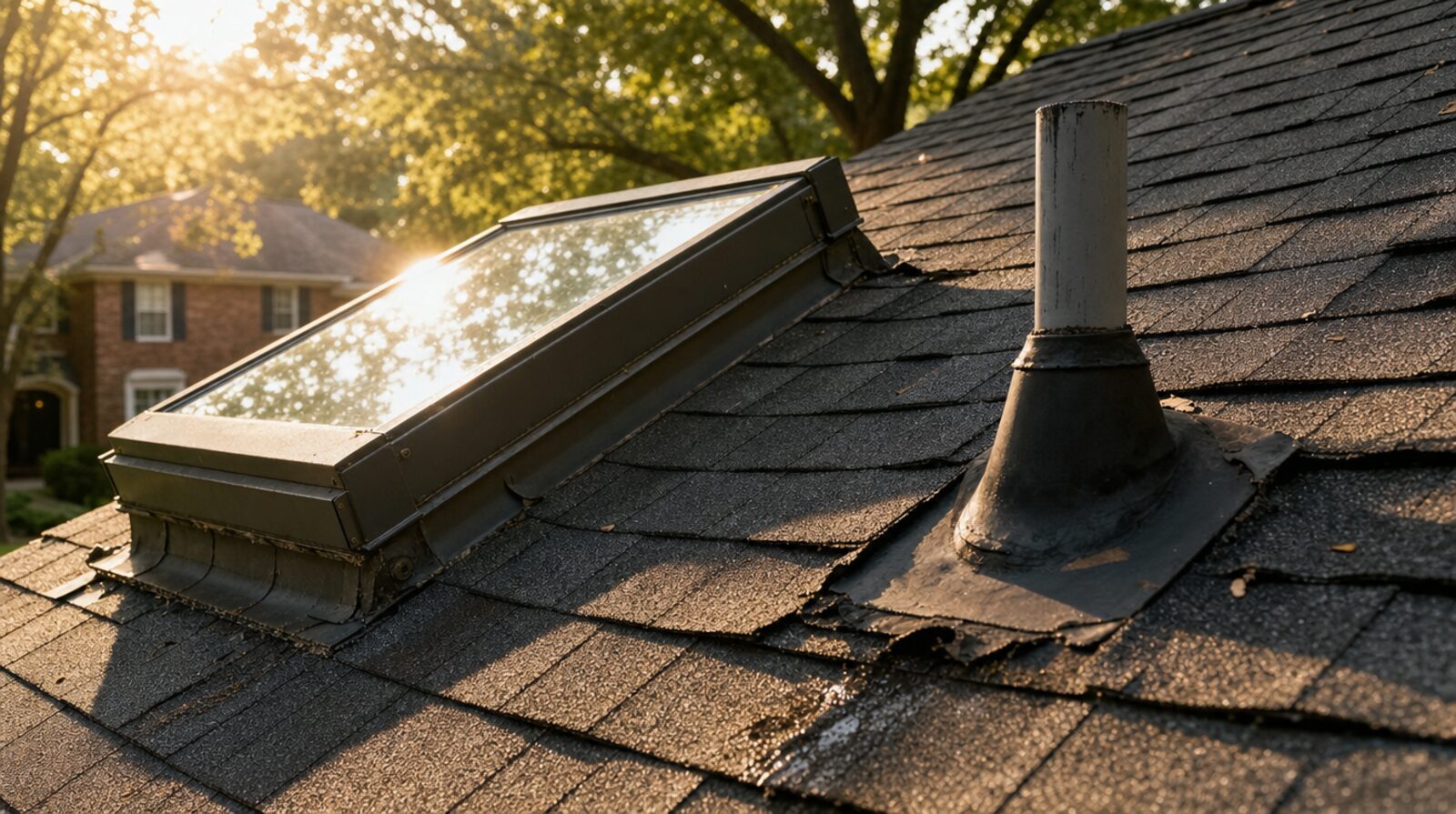
When a homeowner calls us about a ceiling stain, the first question on our minds usually isn't "how old is the roof?" It's "what's poking through it?" After years of climbing roofs all over Greensboro, High Point, and Winston-Salem, we can tell you that the shingles themselves are rarely the problem. It's everything sticking up through them — skylights, plumbing vents, bathroom exhaust fans, chimneys, and roof-mounted HVAC lines — that causes the vast majority of the leaks we get called out to fix.
A roof is really just a big waterproof membrane with a bunch of holes cut into it on purpose. Every one of those holes needs its own flashing detail to stay watertight, and every flashing detail is a place where materials, movement, and time can work against each other. Understanding why these spots fail — and what to watch for — can save you a soggy attic and a ruined ceiling.
Why Penetrations Fail Before the Shingles Do
Shingles are designed to shed water in sheets, overlapping like fish scales so gravity does the work. Flashing around a penetration has a much harder job: it has to seal a joint between two completely different materials — metal or rubber against asphalt shingle, or glass and aluminum against wood decking — that expand, contract, and age at different rates.
- Rubber boot pipe flashings (the ones you see around plumbing vent stacks) have a rubber collar that seals tightly around the pipe. In our climate, with hot, humid summers and freeze-thaw winters, that rubber typically starts cracking and losing its seal well before the surrounding shingles are due for replacement. This is, hands down, the single most common leak source we find on Triad roofs.
- Step flashing around chimneys and skylights relies on small, individual pieces of metal woven in with each shingle course. If a roofer takes a shortcut and uses a single continuous piece of flashing instead — or caulk instead of proper step flashing — it will leak eventually. Caulk is a maintenance item, not a waterproofing system.
- Skylight curbs depend on a four-piece flashing kit (head, step, and sill flashing) that has to be layered correctly with the shingles above and below it. Skylights installed 15-20+ years ago often used flashing kits or sealants that have simply reached the end of their service life, even if the skylight glass itself looks fine.
- Roof-to-wall junctions where a lower roof meets a taller wall (common on additions and dormers) need continuous step flashing tied into the siding with counterflashing or a kick-out flashing at the bottom. Missing kick-out flashing is a notorious cause of hidden wall rot, not just roof leaks.
What a Sneaky Leak Actually Looks Like
The leaks that do the most damage aren't the dramatic ones where water is pouring in during a storm. They're the slow ones that wick along a rafter or run down a pipe for months before showing up as a stain on your drywall — often several feet away from the actual hole. That lag time is exactly why penetration flashing deserves regular attention rather than a look only after you already see a spot on the ceiling.
Signs worth taking seriously:
- A brownish-yellow ring on a ceiling, especially near a bathroom, kitchen vent, or skylight
- Peeling paint or a musty smell in a room directly under the attic near a penetration
- Daylight visible around a pipe boot or skylight curb when you look up into the attic
- Soft or discolored wood decking around a vent pipe when viewed from the attic side
- Granules collecting in gutters right below a chimney or skylight — a sign the flashing (or the shingles cut around it) is deteriorating
- Condensation or fogging inside skylight glass, which points to a failed seal on the unit itself rather than the roof flashing, but is worth having checked at the same time
A Simple Seasonal Check Homeowners Can Do
You don't need to get on the roof to catch most of this early. From the ground with binoculars, or from inside your attic with a flashlight, look for:
- Cracked or curled rubber boots. Rubber pipe collars are usually visible from the ground on a one-story section, and cracking is easy to spot once you know to look for it.
- Rust streaks below metal flashing. Rust stains running down the shingles below a chimney or skylight usually mean the flashing metal itself is corroding.
- Gaps in caulk or sealant around skylight frames, especially on the uphill side where water pressure is greatest during heavy rain.
- Attic daylight test. On a sunny day, turn off the attic light and look for pinpricks of light around any pipe, vent, or skylight shaft. If light gets in, water can too.
- Debris buildup in the valley or crease where a skylight or chimney meets the roof slope — trapped leaves and pine straw hold moisture against the flashing far longer than an open, clear roof surface.
Why This Matters More in the Piedmont Triad
Our stretch of North Carolina sees a real mix of stressors on a roof over the course of a year — humid summers, sharp cold snaps, ice in January and February, and plenty of wind-driven spring and summer thunderstorms. That combination of thermal cycling and heavy rain is tough on flashing seals specifically, because it's the constant expansion and contraction, not just one big storm, that gradually works a seal loose.
If your roof has a skylight, a masonry chimney, or several plumbing vents, it's worth having those penetration points looked at any time you're already having roof work done, and definitely any time you notice a new stain or musty smell inside. Catching a failed pipe boot or a gap in skylight flashing early is a small repair. Catching it after it's soaked into your attic insulation and ceiling drywall is a much bigger job.
A good rule of thumb we tell our customers: if you can name every hole in your roof — every vent, every skylight, every chimney — you're already ahead of most homeowners in the Triad when it comes to preventing leaks.
Stop Guessing on Price
Get precise measurements and a detailed price range for your specific roof right now using our aerial measurement technology. No home visit required.
Get my price