 Back to Guides
Moss and Algae on Your Roof: Cosmetic Issue or Real Problem?


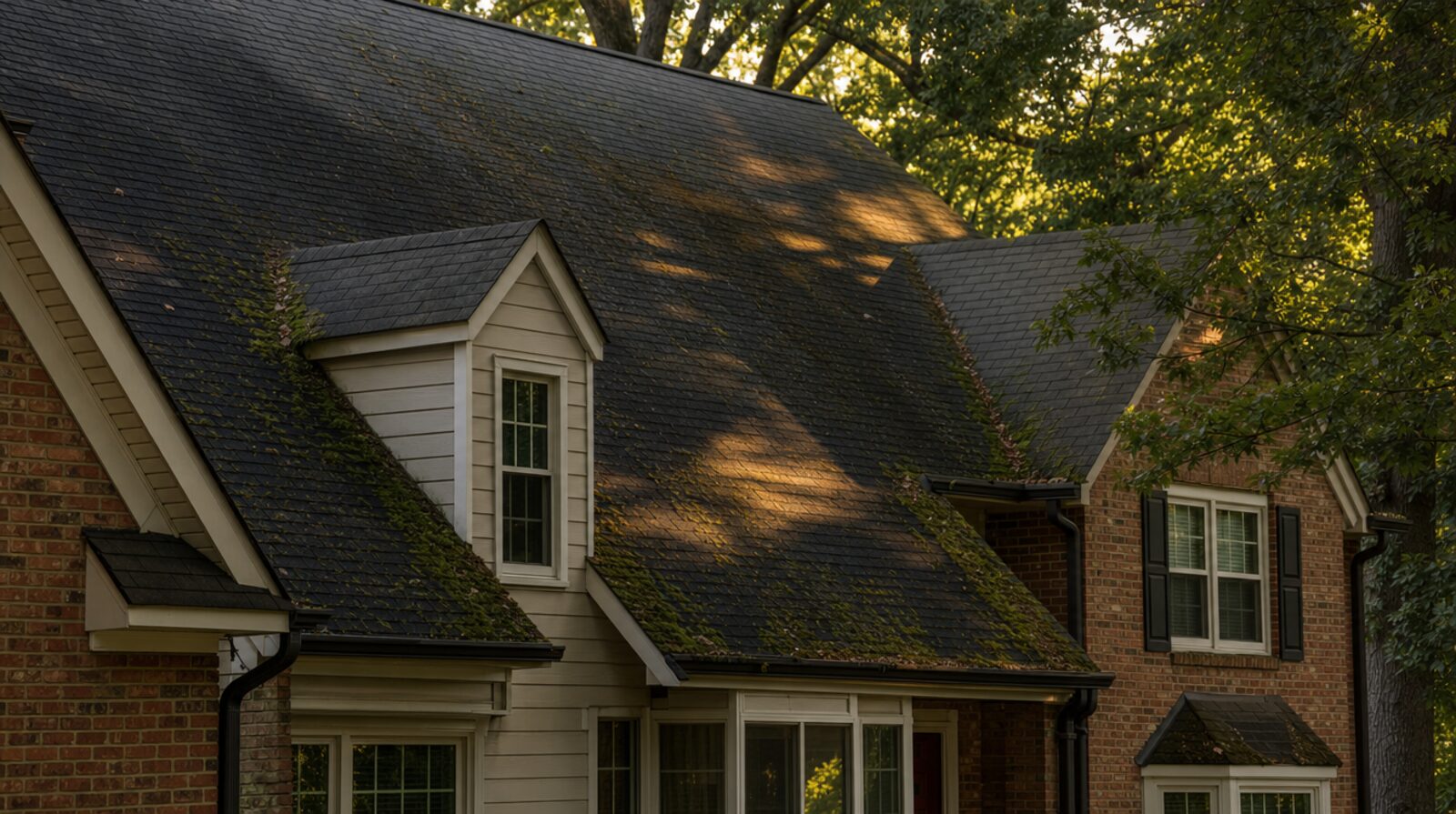
If you've driven through almost any older neighborhood in Greensboro, High Point, or Winston-Salem, you've seen it: roofs with dark streaks running down from the ridge, or patches of green fuzz clinging to the shady side near a tree line. Homeowners ask us about it constantly, usually in one of two ways — either "it's ugly, can you clean it off?" or "is this going to ruin my roof?" The honest answer is that it depends on what you're actually looking at, how long it's been there, and what kind of roof you have underneath it.
Algae Streaks vs. Moss: Two Different Problems
People tend to lump all that roof discoloration together, but algae and moss behave very differently and call for different responses.
Algae streaking is the black or dark gray streaks you see running down a shingle roof, usually starting near the ridge and getting worse over the years. That's typically a blue-green algae called Gloeocapsa magma. It feeds on the limestone filler used in many asphalt shingles, and it spreads by airborne spores — which is why you'll often see the same streaking pattern show up on several roofs in the same subdivision within a couple years of each other. In our climate, with the humidity we get from spring through early fall, algae is close to unavoidable on an older roof, especially one with any shade or tree cover nearby.
Moss is a different animal entirely — literally a plant, not a bacteria. It shows up as raised, textured green or yellow-green clumps, almost always on the north-facing slope or anywhere a roof stays shaded and damp longest. Moss needs organic debris to root into, so it tends to establish first in the granule buildup along shingle tabs, in valleys, and around chimneys and vent boots where leaves and pine needles collect.
Here's the distinction that actually matters: algae staining is mostly cosmetic in its early stages, while moss is mechanically damaging almost from day one. Moss holds moisture directly against the shingle surface and works its root structures — called rhizoids — up under the edges of the shingle tabs. Over time that lifts and separates the shingle layers, and a lifted shingle edge is exactly what wind gets underneath during a summer thunderstorm.
When It's Just Cosmetic — and When It Isn't
A light haze of algae streaking on a roof that's five to ten years old is, realistically, a cosmetic issue. It doesn't mean your shingles are failing. But there are a few signs that tell us it's crossed the line from "needs a cleaning" to "needs attention":
- Raised or spongy patches — if you can see moss standing up off the shingle surface rather than lying flat, it's already lifting tabs underneath.
- Granule loss in the affected area — check your gutters. If you're finding piles of granules where moss or heavy algae has been sitting, that section of shingle is wearing faster than the rest of the roof.
- Persistent damp spots or a musty smell in the attic below a mossy section, which can mean moisture is getting past the shingle and into the decking.
- Curling shingle edges in the same areas where moss has been growing longest.
- Growth on a roof under ten years old — heavy moss that established quickly, rather than the slow algae staining you'd expect over a decade, often points to a spot that never dries out properly: poor attic ventilation, overhanging limbs, or a low-slope section that just doesn't shed water fast enough.
If none of that is present and you're just looking at streaking, you're dealing with an appearance issue and some accelerated aging — not an emergency.
What Actually Works to Remove It
The single most important thing we tell homeowners: never let anyone pressure wash your roof. High-pressure water strips granules right along with the moss and algae, and granule loss is permanent — it doesn't grow back, and it's the beginning of the end for that shingle's UV protection. A pressure washer can turn a cosmetic problem into a five-year-early roof replacement.
What works instead:
- Soft washing with a low-pressure sprayer and a cleaning solution — typically a diluted bleach-and-water mix or a commercial roof cleaner — applied and allowed to sit before a gentle rinse. This kills the organism without abrading the shingle surface.
- Manual removal for moss — a soft brush or a plastic scraper (never metal) to lift the moss clumps off before treating the area, working from the ridge down so you're not forcing water and debris up under shingle edges.
- Zinc or copper strips installed just under the ridge cap. Rain washes trace metal ions down the roof slope every time it rains, which suppresses new algae and moss growth for years. This is the closest thing to a permanent fix and is worth adding any time you're already having roofing work done.
- Trimming back tree limbs so the affected slope gets more direct sun and airflow. Shade is the single biggest factor in how fast moss comes back after a cleaning — if the roof never dries out, the treatment is temporary.
A Word on Prevention
If you're re-roofing and you know your lot has heavy shade — a lot of the older tree-lined streets in our area do — ask about algae-resistant shingles. Most major manufacturers now make a line with copper or zinc granules blended right into the shingle, which gives you that protection built in rather than relying only on strips at the ridge. It costs a bit more up front but it's a smart call on a shaded roof.
Keeping gutters and valleys clear of leaves and debris also goes a long way, since that organic buildup is exactly what moss needs to get started. A quick visual check twice a year — after the leaves drop in fall and again in spring — is usually enough to catch moss while it's still small and easy to remove, long before it's had time to work its way under the shingle edges.
Stop Guessing on Price
Get precise measurements and a detailed price range for your specific roof right now using our aerial measurement technology. No home visit required.
Get my price