 Back to Guides
How Trees Affect Your Roof's Lifespan (and What to Do About It)


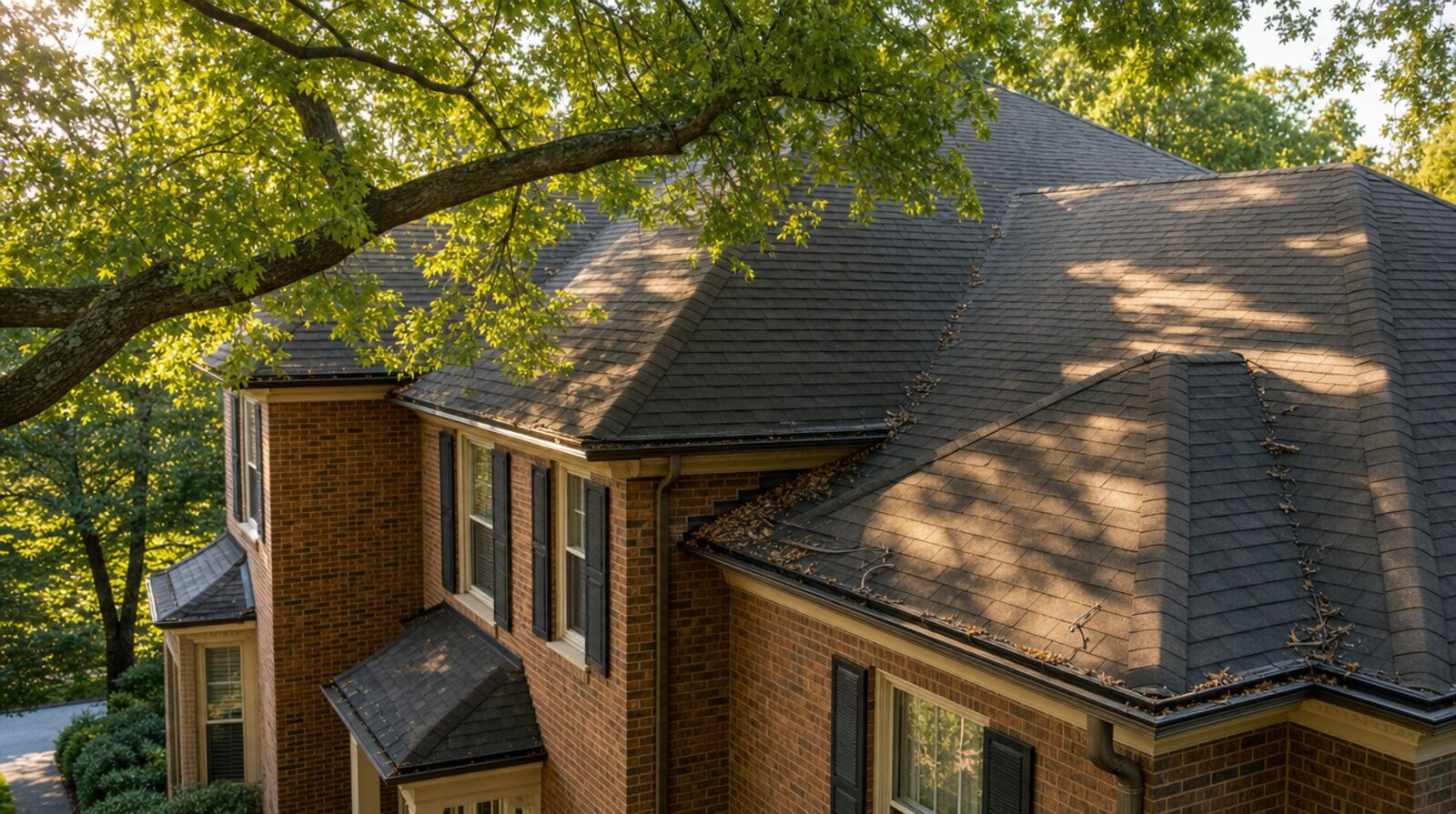
The Piedmont Triad is a beautiful place to own a home partly because of the trees. Greensboro, High Point, and Winston-Salem all have mature tree canopies that keep neighborhoods shaded and cool through our humid summers. But every roof we've climbed under a big oak, maple, or pine tells the same story: trees and roofs have a complicated relationship. Left unmanaged, the same trees that make a yard beautiful can quietly shave years off a shingle roof's life.
This isn't a case for cutting down every tree near your house. It's about understanding exactly how trees cause wear, so you can manage the risk instead of getting surprised by it.
The Four Ways Trees Damage a Roof
When we inspect a roof with tree-related problems, the damage almost always falls into one of these categories.
1. Direct limb contact and abrasion
Branches that touch or hang close to the roof surface don't need a storm to cause damage. Every time the wind blows — and in North Carolina, that's often — those limbs scrape across the shingles. Over months and years, that constant friction wears away the protective granule coating on asphalt shingles, the same way sandpaper wears down wood. Once those granules are gone, the shingle underneath is exposed to direct UV light and moisture, and it ages far faster than the rest of the roof.
2. Moisture that never dries out
Shingle roofs are engineered to dry out between rain events. A section of roof shaded heavily by overhanging branches doesn't get that chance. Shade keeps roof decking cooler and damper for longer after every rain, and that moisture is exactly what algae, moss, and lichen need to take hold. You'll usually spot this first as dark streaking or greenish-black patches on the north-facing slope of a roof, since that side gets the least direct sun. Moss is the bigger concern of the two — its root structure works up under shingle edges and lifts them, which opens a path for water intrusion.
3. Clogged gutters and valleys
Leaves, pine straw, and seed pods don't just pile up in gutters — they collect in roof valleys, around chimneys, and behind any point where two roof planes meet. When debris dams up water in a valley, that water has nowhere to go but backward, under the shingles. We see this most often in the fall and again in early spring when oak trees drop their old leaves. A gutter that overflows during a heavy rain is frequently a symptom of a debris problem up on the roof itself, not just in the gutter.
4. Sudden limb failure
This is the damage everyone thinks of first, and it's real — a large limb coming down in a storm can crack decking, puncture shingles, or take out a whole section of roof in seconds. But in our experience, the slow damage from abrasion, shade, and clogged drainage costs homeowners more over the life of a roof than sudden limb failure does. It's just less dramatic, so it gets ignored.
What Actually Helps
- Keep branches trimmed back at least 6 to 10 feet from the roofline. This is the single most effective thing you can do. It stops abrasion entirely and lets enough sunlight and airflow reach the roof surface to dry it out properly after rain.
- Clean gutters at least twice a year — once in late fall after leaf drop is mostly finished, and again in late spring after trees have finished shedding seed pods and flower debris. Homes with heavy tree cover often need a mid-winter check too.
- Clear valleys and low-slope areas by hand or with a blower, not just the gutters. A leaf blower from the ground can knock loose debris out of easy-to-reach valleys; anything higher or steeper should be handled carefully from a ladder or left to a professional.
- Watch the north-facing and heavily shaded slopes for early streaking or moss. Catching it early means a simple cleaning; letting it sit for a season or two often means replacing shingles.
- Have a certified arborist assess any tree with dead limbs, visible lean, or root damage near your house, especially after a wet winter when root systems are more prone to failure.
- Walk your yard after any significant wind event and look up, not just down. Cracked or hanging limbs that haven't fallen yet are often more dangerous than the ones already on the ground.
When It's Time to Call Someone
A little moss in a shaded corner or a few extra trips up the ladder to clear the gutters is normal maintenance. It's time to get a roof looked at when you notice granules collecting in the gutters or at downspout outlets, soft or sagging spots in the decking, water stains on interior ceilings near an exterior wall, or shingles that look curled or cracked specifically in the areas under tree cover. Those are signs the damage has already moved past the surface.
A roof under a mature tree canopy isn't doomed — it just needs a maintenance rhythm that accounts for what's hanging over it. The homeowners who stay ahead of it get a full service life out of their roof. The ones who don't usually end up replacing shingles years earlier than they should have.
If you're not sure whether the trees around your home are helping or hurting your roof, it's worth having a contractor familiar with the area take a look. Tree damage patterns in a Winston-Salem neighborhood full of tall oaks look different from a High Point home with pines nearby, and knowing which one you're dealing with changes what maintenance actually matters.
Stop Guessing on Price
Get precise measurements and a detailed price range for your specific roof right now using our aerial measurement technology. No home visit required.
Get my price