 Back to Guides
Gutter Maintenance 101: Why Clogged Gutters Are a Roof's Worst Enemy


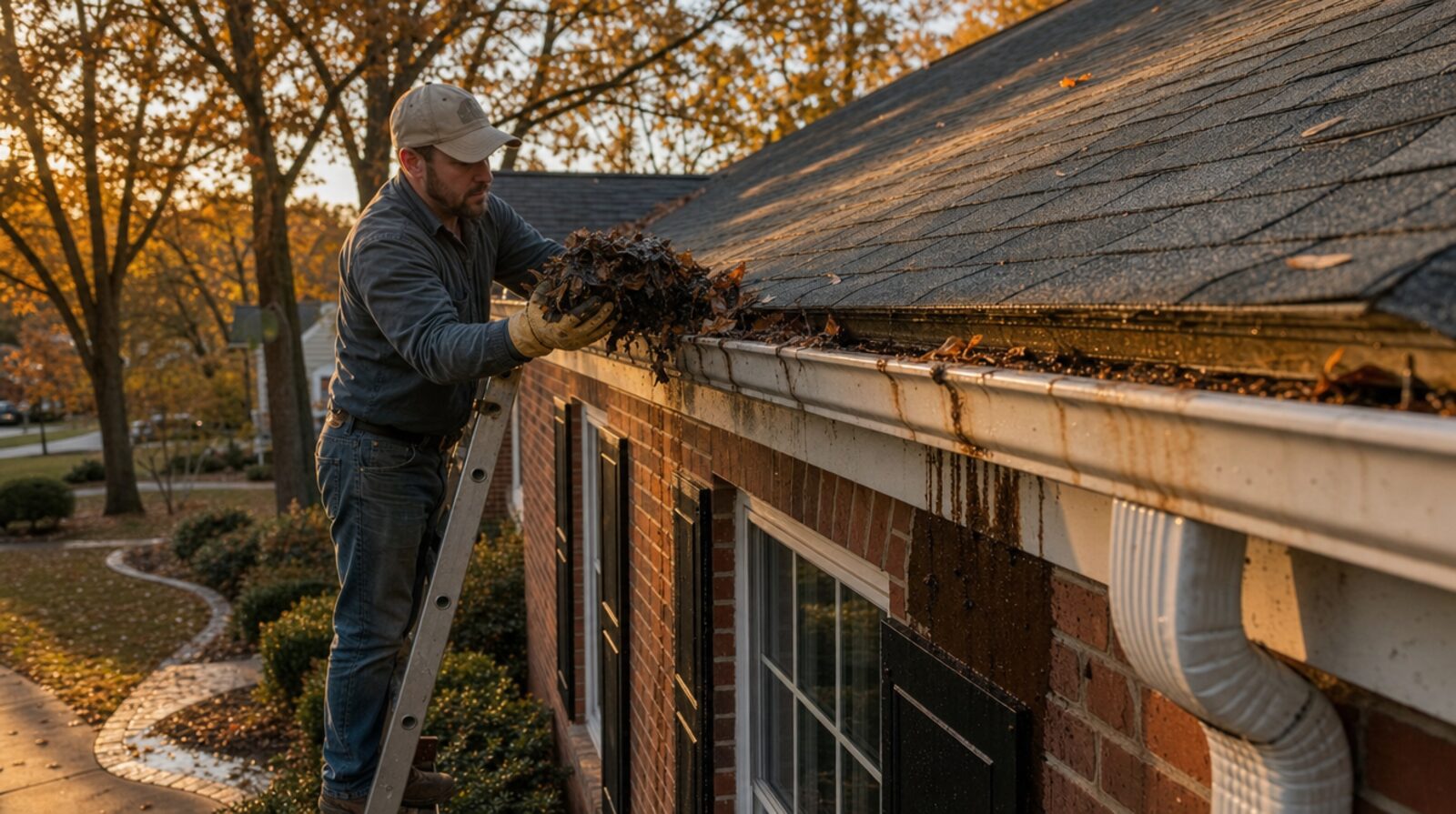
Every fall, we get calls from homeowners who noticed a stain spreading across their ceiling and assumed the worst — a bad roof. More often than not, when we get up there, the shingles are fine. The gutters are the problem. They're packed with wet leaves, water has nowhere to go, and it's been sitting against the roof deck and fascia board for weeks. Gutters don't get much attention until they fail, but they're doing more work than most people realize, and neglecting them is one of the fastest ways to turn a cheap fix into an expensive repair.
What Clogged Gutters Actually Do to Your Roof
A gutter system's only job is to move water off your roof and away from your house. When it can't do that, the water doesn't just disappear — it finds the next easiest path, and that path usually runs straight into your home's structure.
- Ice and water backup. Even here in the Piedmont, we get enough freezing nights each winter for ice dams to form at clogged gutter lines. Water backs up under the shingles above the dam, soaks the underlayment, and can leak into the attic.
- Fascia and soffit rot. The fascia board is what your gutters actually hang on. When gutters overflow or hold standing water, that board stays wet far longer than it should, and untreated wood starts to soften and rot within a season or two. Once the fascia goes, the gutters have nothing solid to hang from.
- Roof edge and decking damage. Overflowing water running back under the shingle edge and drip edge is one of the more common causes of slow, hidden leaks we find on inspections — the kind that don't show up as a ceiling stain until the plywood decking underneath has already gone soft.
- Foundation and crawlspace problems. Water that overshoots clogged gutters lands right at the foundation line instead of being carried a safe distance away by the downspout. Over time that leads to soil erosion, basement seepage, and settling — problems that have nothing to do with your roof but start with your gutters.
- Pest and mold entry points. Standing organic debris in a gutter is basically a planter box. It holds moisture against the fascia, attracts carpenter ants and wood-boring insects, and gives mold and mildew a place to take hold right at the roofline.
How Often to Clean Them in the Piedmont Triad
Our tree cover in Greensboro, High Point, and Winston-Salem means most homes need gutter cleaning more often than the national "twice a year" advice you'll read online. A general rule for this area:
- Late spring (May/June): Clear out the seed pods, pollen buildup, and winter debris before summer thunderstorm season hits.
- Fall (October/November): This is the big one. Wait until most of the leaves have dropped, not before, or you'll be back up the ladder in three weeks.
- Extra check after major storms: Heavy wind and rain knock loose branches, shingle granules, and debris into gutters year-round. If you've had a rough storm blow through, it's worth a quick visual check from the ground.
If your property has a lot of oak or pine coverage directly over the roofline, you may need a third cleaning mid-winter. Pine needles in particular mat down and clog faster than broad leaves.
What to Check While You're Up There
Cleaning is only half the job. While the gutters are exposed, take a few minutes to check the condition of the system itself:
- Sagging sections. Gutters should have a slight, consistent pitch toward the downspout — roughly a quarter inch of drop for every ten feet of run. Standing water after a clear day usually means a section has sagged or a hanger has pulled loose.
- Loose or missing hangers. Gutter hangers should sit every two to three feet. If you can wiggle a section of gutter by hand, the hangers are failing.
- Separated seams and end caps. Look for rust streaks or water stains running down the siding below a joint — that's usually where a seam has opened up.
- Downspout flow. Run a hose through the gutter and confirm water exits freely at the bottom of each downspout. A slow drain usually means a clog lower in the run, sometimes at an underground extension if you have one.
- Shingle granules in the gutter. A little grit is normal, especially on a newer roof. Heavy, consistent granule loss is worth mentioning to a roofer — it can be a sign the shingles are aging out.
Gutter Guards: Worth It or Not?
We get asked about gutter guards constantly, and the honest answer is: it depends on your trees. Guards reduce the volume of leaf debris that collects, which cuts down cleaning frequency, but no guard on the market eliminates maintenance entirely. Fine debris like pine needles, seed pods, and roof grit still gets through most mesh and screen systems, and guards can make it harder to spot a developing problem, like a sagging hanger, until it's worse. If you go with guards, plan on an annual inspection at minimum — just skip the twice-a-year full clean-out.
When to Call a Professional
A single-story home with easy ground access is a reasonable DIY job if you're comfortable on a ladder and follow basic safety practices — solid footing, a spotter, and never leaning out past the ladder's rails. Beyond that, we'd rather see a homeowner call a contractor than risk a fall. It's also worth having a roofer take a look anytime you notice recurring overflow in the same spot, water stains on siding or fascia, or a section of gutter that's pulled away from the house. Those are usually symptoms of a problem that started at the roofline, not just a gutter that needs a scoop and a hose.
A roof can be in great shape and still suffer real damage from a gutter system that isn't doing its job. They're not glamorous, but they're one of the cheapest forms of roof insurance you've got.
Stop Guessing on Price
Get precise measurements and a detailed price range for your specific roof right now using our aerial measurement technology. No home visit required.
Get my price