 Back to Guides
Commercial Flat Roofs: TPO vs. EPDM for Triad Businesses


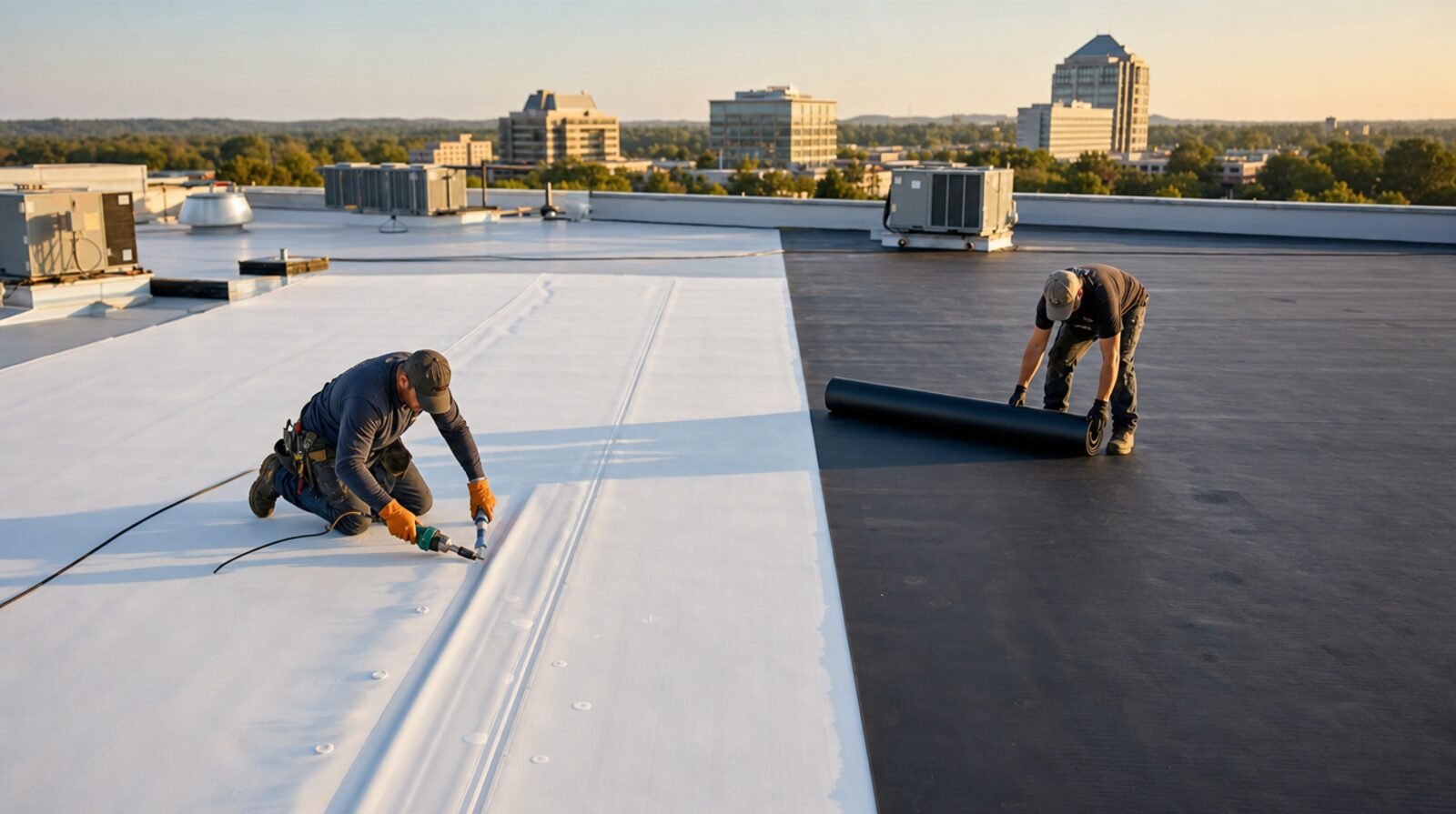
Walk the roof of any strip mall, warehouse, or office park in Greensboro, High Point, or Winston-Salem and you're almost certainly standing on one of two membranes: TPO or EPDM. Both are single-ply systems, both have been the go-to choice for low-slope commercial roofs for decades, and both will outlast a lot of the equipment bolted on top of them if they're installed right. But they are not interchangeable, and picking the wrong one for your building has cost more than one Triad business owner a premature reroof.
We get asked "which one is better" almost every time we bid a commercial reroof. The honest answer is that it depends on your roof's exposure, your rooftop equipment, and your budget — not on which material is trendier. Here's how we actually walk through that decision with building owners.
What each membrane actually is
EPDM (ethylene propylene diene monomer) is a synthetic rubber membrane that's been on commercial roofs since the 1960s. It's almost always black, it comes in large sheets, and the seams are either glued with liquid adhesive or joined with seam tape. It's flexible even in cold weather, which matters more than people think during a January install in the Piedmont.
TPO (thermoplastic polyolefin) is newer — it became the dominant commercial choice starting in the late 1990s and early 2000s as building owners moved away from EPDM's dark surface and solvent-based seaming. TPO sheets are heat-welded at the seams instead of glued, which fuses adjacent sheets into essentially one continuous membrane. It's most commonly white or light gray, though gray and tan options exist.
Where they differ on a real building
- Heat reflectivity. White TPO reflects a significant amount of solar radiation, which can measurably reduce rooftop and top-floor cooling loads during a Piedmont summer. Black EPDM absorbs heat instead — on some buildings that's a problem, on others (like a building that needs help shedding snow load or staying warmer in winter) it's actually a minor advantage.
- Seam strength. Heat-welded TPO seams fuse the sheets together, and when done correctly they're often stronger than the field membrane itself. EPDM's glued or taped seams have historically been the weak point of the system — most EPDM roof leaks we're called out for in the Triad start at a seam, not in the middle of a sheet.
- Puncture and impact resistance. EPDM's rubber composition tends to handle foot traffic, hail, and rooftop equipment moving across it a little better than thinner TPO. If your roof sees a lot of HVAC service traffic, membrane thickness matters more here than which material you choose.
- UV and chemical exposure. TPO's formulation has improved a great deal since its early years, but it's still worth asking your contractor about the specific manufacturer and thickness — early-generation TPO had a reputation for seam and surface issues that the industry has largely engineered around. EPDM has a much longer track record simply because it's been in the field longer.
- Grease and restaurant exhaust. If your building has a commercial kitchen — a restaurant, a shopping center anchor, a food court — grease-laden exhaust degrades EPDM faster than TPO. We steer restaurant and food-service clients toward TPO for that reason almost every time.
What actually drives the decision on your building
In our experience walking Triad commercial roofs, the choice usually comes down to a handful of practical factors rather than a blanket "TPO is better" or "EPDM is better" answer:
- Roof age and what's already up there. If you're recovering an existing EPDM roof that's still structurally sound, staying with EPDM is often the more economical path. Tearing off a functioning membrane to switch systems rarely pencils out unless there's a specific performance reason to do it.
- Rooftop equipment and kitchen exhaust. Restaurants and food-service tenants push us toward TPO. Buildings with heavy foot traffic or exposed equipment corridors sometimes do better with a thicker EPDM.
- Cooling costs. A single-story warehouse or retail box with a large flat roof and significant AC load is usually a good candidate for white TPO's reflectivity.
- Installer experience. This matters more than either material spec. A well-installed EPDM roof will outperform a poorly heat-welded TPO roof every time. Ask your contractor how many TPO seams they've welded and whether they test seam integrity with a probe during installation — that's a fair question to ask any commercial roofer bidding your project.
- Budget and membrane thickness. Both systems come in a range of thicknesses (commonly 45 mil to 90 mil for EPDM, 45 mil to 80 mil for TPO). Thicker membrane costs more up front but generally means fewer punctures and a longer service life — worth discussing against your building's specific traffic and exposure.
Maintenance either way
Whichever membrane you choose, a flat commercial roof needs a maintenance rhythm that pitched residential roofs don't:
- Walk the roof twice a year — spring and fall — checking drains, scuppers, and gutters for debris that causes ponding.
- Inspect seams and flashing around every rooftop penetration: HVAC curbs, pipe boots, conduit, and parapet walls.
- Clear ponding water within 48 hours where possible; standing water is the single fastest way to age either membrane prematurely.
- Document any patch work with date and location so your next inspection can track whether repairs are holding.
Both TPO and EPDM, properly installed and maintained, are proven systems that have protected Triad businesses for a long time. The wrong choice usually isn't "TPO vs. EPDM" in the abstract — it's mismatching the membrane to your building's actual exposure, tenant mix, and rooftop traffic. That's the conversation worth having with your roofer before the tear-off crew ever shows up.
Stop Guessing on Price
Get precise measurements and a detailed price range for your specific roof right now using our aerial measurement technology. No home visit required.
Get my price