 Back to Guides
3-Tab vs. Architectural Shingles: What's the Real Difference?


Every week somebody stands in their driveway with a handful of shingle samples asking us the same question: what's actually different between 3-tab and architectural shingles, besides price? It's a fair question. From the ground, especially on an older roof, they can look similar. Up close — and after a Piedmont summer storm season — they're not the same product at all.
What Sets Them Apart
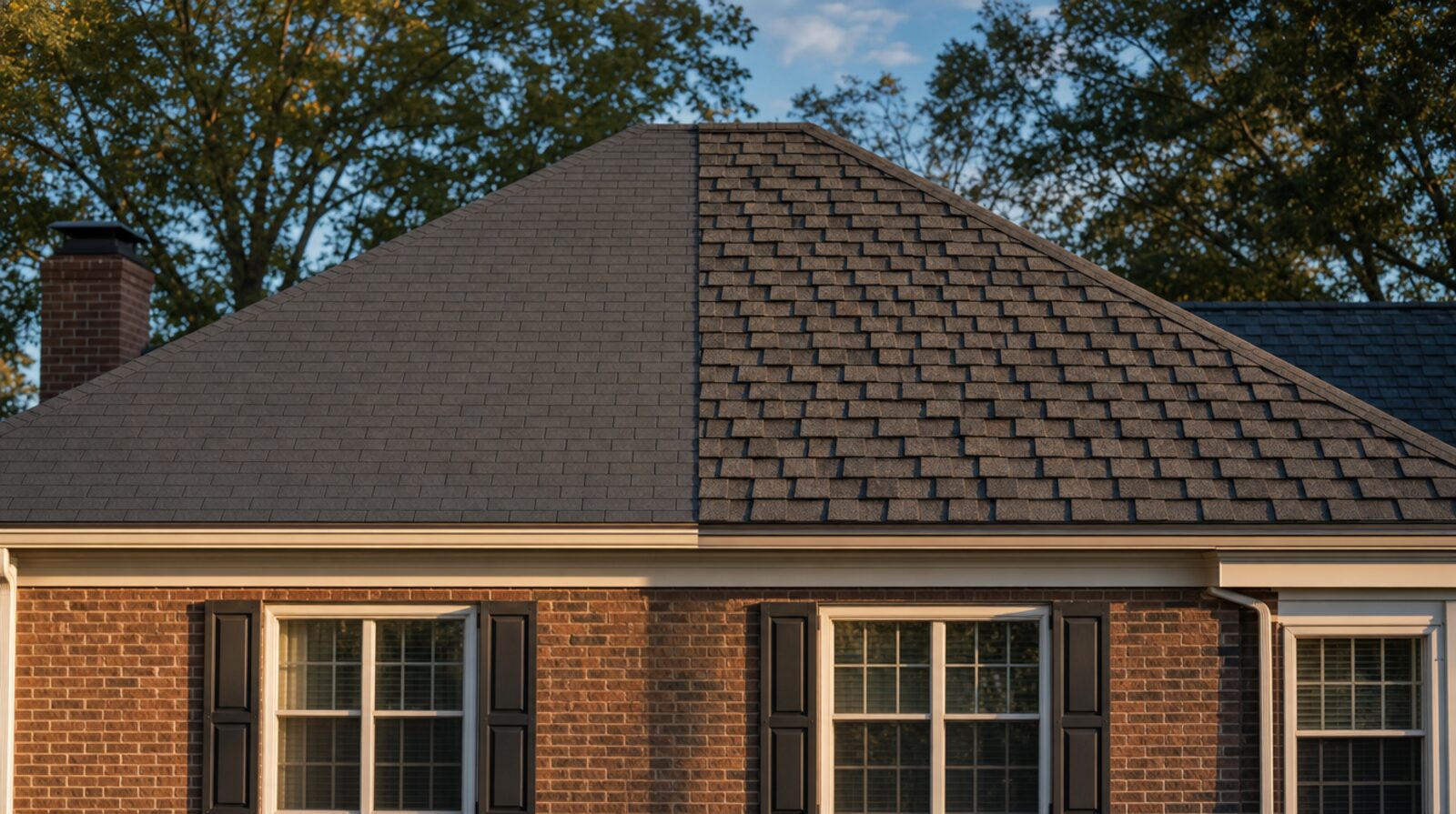
A 3-tab shingle is a single layer of asphalt cut into three even tabs, so every shingle on the roof is the same size, shape, and thickness. That uniformity is exactly what gives an older roof that flat, almost paper-like look when you drive by it. They're lighter, thinner, and generally the lower-cost option per square.
Architectural shingles — sometimes called dimensional or laminate shingles — are built from two or more layers of asphalt fused together, with tabs cut in varying shapes and offset patterns. That extra layer isn't just for looks. It adds thickness and mass to the shingle, which is a big part of why architectural products carry higher wind resistance ratings and heavier weights per square than 3-tab.
- Construction: 3-tab is single-layer and flat; architectural is multi-layer and dimensional.
- Weight: Architectural shingles typically run noticeably heavier per square, which matters for how well they lie down and resist lifting in wind.
- Appearance: 3-tab has a uniform, repeating pattern. Architectural shingles have randomized tab shapes and shadow lines that mimic the look of natural slate or wood shake from the street.
- Lifespan: Architectural shingles are generally built for a longer service life than 3-tab, though actual performance depends heavily on installation quality, attic ventilation, and how much direct sun and storm exposure the roof takes over the years.
Why It Matters for a Triad Roof
Our weather isn't gentle on shingles. We get hot, humid summers that bake asphalt from above, sudden thunderstorms with gusty straight-line winds, and the occasional ice event in winter that stresses shingle edges as they expand and contract. 3-tab shingles, being a single layer, have less mass to resist wind uplift at the tab edges — that's usually where you'll see the first signs of trouble after a rough storm, with tabs cracking or blowing off individually.
Architectural shingles handle that kind of stress better because the laminated construction distributes wind load differently and the heavier weight helps the shingle stay seated. That's a big reason we've seen the market shift hard toward architectural over the last several years — most manufacturers have scaled back their 3-tab lines, and on new construction and full replacements in this area, architectural has become the default rather than the upgrade.
There's also a practical repair consideration. Because 3-tab shingles are uniform, matching an older roof after a partial repair is usually straightforward as long as you can still get the same product line. Architectural shingles vary more by manufacturer and even by production run, so if you're patching an older architectural roof, color and texture matching can be trickier — one more reason to keep a few spare bundles from the original installation if you have them.
Cost and Where It Actually Shows Up
3-tab shingles cost less per square, both in material and typically in labor, since they're lighter and faster to lay in a straightforward pattern. Architectural shingles cost more upfront. Where that cost difference tends to even out is over the life of the roof — fewer wind-related callbacks, a longer expected service life, and better resale perception. Buyers and appraisers in this market generally recognize architectural shingles as the higher-quality product, and it can matter at closing time if you're selling within a few years of a new roof.
If you're weighing the two for a full replacement, ask your contractor about:
- The wind rating for the specific product line, not just "architectural" as a category — ratings vary by manufacturer.
- Warranty coverage details and what voids it (attic ventilation requirements catch a lot of homeowners off guard).
- Whether the shingle color and style you like is a current, in-production line, so future repairs are easier to match.
Our Recommendation
For most homes we work on in Greensboro, High Point, and Winston-Salem, we steer customers toward architectural shingles unless there's a specific budget constraint or the home's style genuinely calls for the flatter 3-tab look. The wind performance and appearance are worth the difference for most families planning to stay in their home more than a few years. That said, a properly installed 3-tab roof, on the right structure, with good ventilation and flashing detail, will still serve a homeowner well — installation quality and proper attic ventilation matter as much as which shingle you choose.
If you're not sure which makes sense for your roof, walk it with a contractor before you commit. Roof pitch, sun exposure, tree cover, and even the direction your prevailing storms come from all factor into the right call.
Stop Guessing on Price
Get precise measurements and a detailed price range for your specific roof right now using our aerial measurement technology. No home visit required.
Get my price